 P13
P13 P14
P14Edition 008 · Complete authoritative text
The phrase creator is too small for some of the work it is being asked to hold.
One person may move from audience research to scripting, filming, editing, client review, publishing, disclosure, invoicing, file storage, performance reporting, and the question of whether the finished work may appear in a portfolio. That is not a claim that every creator performs every function, or that everybody should. It is a way to notice how many different kinds of decisions can accumulate around one apparently simple deliverable.
The finished post makes the labor look simultaneous. It was not.
Someone had the idea. Someone translated it into instructions. Someone decided what evidence was strong enough, which music could travel with the video, what the client meant by “final,” which version had actually been approved, which account would publish, whether the content would become an advertisement, and what should happen after the campaign ended.
Sometimes all of those someones are one person.
Creators describe this work in the language of time, scattering, and attention. One current creator wrote that ideas lived in four different places and called the resulting setup “organized chaos.” Another described weeks containing writing, testing, recording, scripting, and research at once. A photographer explained that asset management was not the interesting part of the work—then described losing unbacked-up photographs and building a routine so it would not happen again.
These are individual accounts, not prevalence data. They are enough to reveal the practical question underneath this series:
What does one person need in order to make a multi-role body of work legible, governable, and capable of continuing?
I use Institution of One to describe that operating condition: one person carrying a changing set of roles, assets, relationships, decisions, and continuities. Not a lonely worker pretending to be a corporation. Not a demand that one person do everything. An institution becomes visible when the work can no longer be understood as the output file alone.
A pile of tools is not yet a system
It is possible to have a calendar, cloud drive, task board, notes app, contract folder, invoice platform, editing suite, and client portal—and still be unable to answer a basic question.
Which file did the client approve?
The problem is not necessarily missing software. It may be missing relationships among the records. The brief names one deliverable. The contract authorizes a different route. The editing notes refer to “the latest version.” The exported file is called `FINAL_v2_REALFINAL.mp4`. The paid-media team receives a copy without the usage end date. The creator remembers the exception, but the project does not.
That is organized material without institutional memory.
A system begins when the records can answer one another:
- the brief identifies what is being made;
- the agreement or other permission record identifies what may be done;
- the version record identifies what changed and what was approved;
- the route record identifies where, how, and for how long the asset may travel;
- the contribution record identifies who supplied what and what they still need;
- and the closeout record identifies what stops, remains, renews, returns, or becomes reusable.
No particular app creates those relationships automatically. A folder can hold the wrong file beautifully. A task can be marked complete while an advertisement is still running. A comment thread can document ten revisions without identifying which one became the approved asset.
The point is not maximal administration. It is enough structure to recover the consequential facts without asking one person’s memory to remain the sole database.
The brief is where the institution first becomes visible
Consider a deliberately compressed example:
One short-form video. Full usage. Worldwide. Perpetual. Category exclusivity. Raw files included.
It is short enough to fit in an email subject line. Operationally, it opens a room full of questions.
Which account publishes? Does “full usage” mean reposting, embedding, native uploading, paid advertising, retailer placement, or all of them? May the work be cropped, translated, dubbed, cut down, or paired with new claims? Does “worldwide” describe technical availability or intended commercial markets? Which companies and products fall inside the exclusive category? What does “perpetual” mean for active advertising, archived campaign pages, and future renewal? Which raw materials exist, who contributed to them, and are the music, fonts, locations, collaborators, and bystanders cleared for every proposed route?
The example does not establish that this exact language is common or intentionally misleading. It shows how little shorthand is required to hide several different production decisions.
A useful production brief can make those decisions visible before work begins:
- objective and intended audience;
- finished deliverables and technical specifications;
- contributors, source materials, and third-party elements;
- revision rounds, approvers, and the meaning of “final”;
- publishing accounts, placements, and dates;
- organic, paid, retail, email, embed, and other routes;
- permitted edits, cutdowns, translations, and adaptations;
- identity, endorsement, and disclosure requirements;
- duration, territory, exclusivity, renewal, and stop conditions;
- source-file access and delivery;
- measurement and reporting; and
- closeout, archive, portfolio, and reuse decisions.
This is an RN-authored checklist, not an industry standard. It is also not a declaration that the brief replaces the governing agreement. Labels do not determine legal effect. The brief can organize the production facts so the agreement, permissions, workflow, and price can be compared against the same proposed campaign.
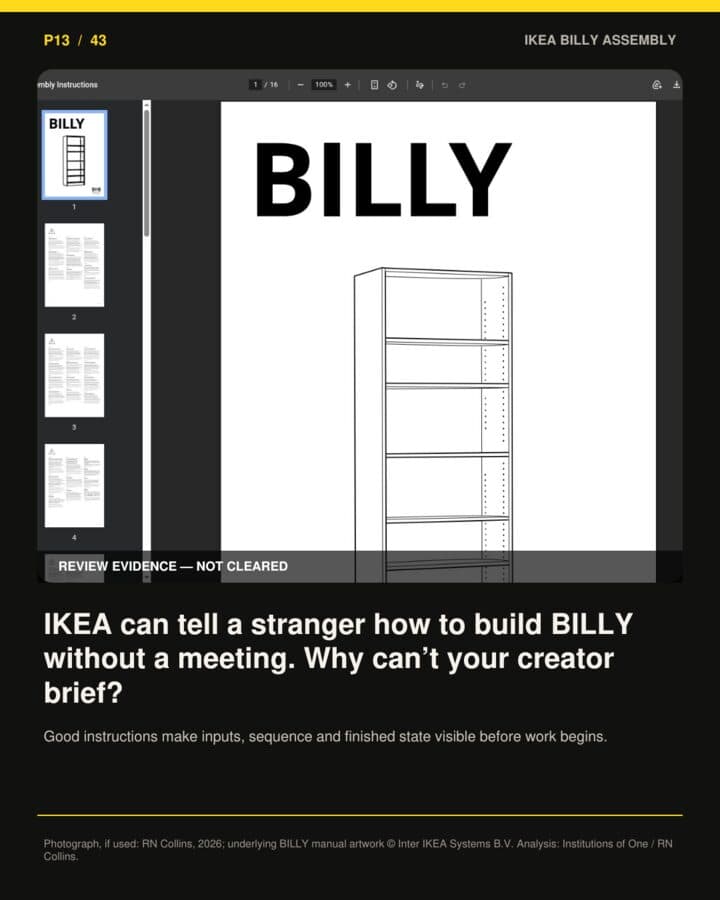
IKEA’s official support system offers a modest analogy. Its product pages provide downloadable assembly instructions, and its tutorials make sequence visible step by step. The analogy proves nothing about creator outcomes. It simply clarifies the function of instructions: a box may contain every correct part while still leaving the assembly relation unresolved.
The same can be true of a creator campaign. The assets may all exist. The future route may still be unintelligible.
“Latest” is not a version name
Version control sounds technical until two people remember two different approvals.
Current Google Docs help shows a user can inspect who updated a file and what changed, name versions, and copy an earlier version. Current Adobe documentation describes review workflows where collaborators can attach comments to particular video frames, preserve commenter and time information, update shared content through an existing review link, or create a separate link for a new version.
Those features do not make either product a complete legal evidence system. Version history can be managed or deleted. Interface behavior changes. A recorded comment may still be ambiguous. A team may review one link and publish another file.
But the mechanics make an important distinction visible: a file, a revision, a comment, and an approval are not the same record.
A practical handoff should be able to identify:
- the exact asset and version being handed over;
- the source package included or excluded;
- the open comments and the resolved comments;
- the person authorized to approve;
- the approval date and approved route;
- any remaining disclosure, rights, access, or expiry condition; and
- where the next person should record a change.
The value is not that a platform remembers everything forever. It is that the people decide which facts must remain recoverable and attach them to the asset before the context disappears.
The contribution map
A campaign may involve a creator, brand, agency, editor, musician, designer, performer, platform, retailer, affiliate, and audience. Not every project includes every participant. The list matters because the finished post can make distinct contributions look like one undivided object.
The contribution map is another RN-authored tool. For each actual participant, ask:
- What did they contribute? A concept, script, performance, recording, design, product, location, approval, audience relationship, distribution route, or money?
- What may they do? Publish, edit, advertise, archive, display, license, measure, approve, or stop?
- What do they need from someone else? A file, release, credit line, disclosure, payment, access credential, report, or decision?
- What must remain available later? The agreement, source material, approved export, license, invoice, metric, renewal date, or portfolio permission?
This is a tool to test, not a validated audit standard. Its usefulness depends on whether it catches the contribution or dependency the ordinary project view would have hidden.
That fourth question begins the work of continuity. A post may be published once while invoices, usage periods, disclosure records, release forms, edit files, renewals, reporting obligations, and portfolio permissions remain active on different clocks.
Build, Carry, Control, Continue
I organize this system through four verbs.
Build
What is being made?
Build identifies the question, audience, deliverables, contributors, production method, evidence, revisions, and exact finished outputs. It is not only the creative act. It is the record of how the proposed work becomes an identifiable asset.
Carry
What must travel with the operator or project?
Carry includes the files, credits, relationships, knowledge, platform histories, obligations, and explanation that connect one stage to the next. The audience research did not reveal one universal method. It revealed creators trying folders, calendars, routines, automation, and continually changing systems. Carry is not a demand for a perfect second brain. It asks which context becomes dangerous to lose.
Control
Which consequential choices must remain visible and exercisable?
Control includes permissions, approvals, access, editing, amplification, placement, duration, territory, exclusivity, disclosure, and stop conditions. It is an organizing verb, not a synonym for copyright ownership. Copyright, contract, endorsement rules, platform permission settings, and practical access may allocate different forms of authority to different people.
Continue
What survives the launch?
Continue includes the records relevant to archive, renewal, takedown, metrics, invoices, case studies, learning, and future reuse. Not every project needs every record. The closeout question is whether the project can distinguish what has ended from what remains alive.
Together, the verbs turn a one-time exchange into something that can be inspected over time.
The campaign decision record
Every project does not need a bureaucracy. It may need one good page.
Build
- What was commissioned?
- What exact assets and versions were delivered and approved?
- Who contributed what?
Carry
- Which files, evidence, releases, credits, relationships, and explanations must be preserved?
- What may enter a portfolio or knowledge base?
Control
- Who may use, edit, amplify, place, sublicense, or stop each asset?
- What identity, disclosure, market, duration, and exclusivity limits apply?
- Who approves an exception?
Continue
- When does each active use end?
- What must be removed, archived, renewed, measured, paid, returned, or revisited?
- Where is the final record, and who can access it?
I call this record a memory prosthetic. That is a metaphor, not a medical claim. The page does not improve memory by magic. It moves selected facts out of one person’s head and into a record another person—or the same person six months later—can inspect.
Until it is field-tested against a neutral project, it should be treated as a proposed tool. The test is simple: can the page reconstruct what was built, carried, controlled, and left to continue without reopening every email, app, drive, and message thread?
Professionalization beyond polish
It is easy to mistake professionalization for aesthetic polish: a cleaner media kit, a confident rate card, a better camera, a consistent feed.
Those things may help. The deeper institutional questions are less visible.
Can the operator explain the exchange? Locate the governing record? Identify the approved version? Price a proposed change in scope? Trace a factual claim? Find the relevant source file or license? Stop or escalate an expired use? Hand the project to an editor without losing its logic? Build a case study without violating the arrangement that produced it?
An Institution of One becomes more durable when the answer does not depend entirely on what one exhausted person can remember today.
The system remembers only what the person chose to make legible.
Keepable tool: the one-post institution map
For the next sponsored post—or any project with several people, assets, routes, or future obligations—test this map:
- Purpose: What change is the work meant to create, for whom?
- People: Who contributes, appears, approves, publishes, receives, and pays?
- Assets: What finished, source, evidence, and derivative materials exist?
- Rights: What may each participant do, under which record?
- Route: Where, how, how long, and in which markets may the work travel?
- Limits: Which edits, identity uses, disclosures, exclusions, and stop conditions apply?
- Memory: Which files, dates, versions, approvals, and decisions must survive?
- Learning: What result, correction, failure, or audience response should change the next cycle?
The map is not the institution. It is a way to see whether one exists—and where it may fail next.
Sources and further reading
- U.S. Copyright Office, Circulars: Copyright Basics and How to Obtain Permission
- 17 U.S.C. Chapters 1 and 2
- Federal Trade Commission, Endorsements, Influencers, and Reviews
- Meta, Creator Marketplace and Partnership Ads
- Meta Help, Partnership Ads and Branded Content Eligibility
- YouTube Help, Embed Videos and Playlists
- Google Docs Editors Help, Find Out What’s Changed in a File
- Adobe Premiere, Share for Review with Frame.io
- Adobe Premiere, Import Frame.io Comments as Markers
- IKEA, Assembly Instructions
- A4 audience-language research record: 15 dated excerpts from six direct creator/writer sources; disclosed partial corpus held in the internal editorial file.
General educational information, not legal advice. The maps and checklists are RN-authored preparation and coordination tools, not substitutes for advice about a specific agreement, law, platform, or jurisdiction.