A self-managed creator negotiates one Instagram Reel. The email is clear: one post, no organic reuse by the brand, no paid use, no exclusivity. Then the contract arrives.
Inside the legal language, the route has expanded. The brand may be able to repost the work, advertise with it, adapt it, move it across platforms, use it through the creator’s account identity, or restrict the creator’s work with other companies. The creator has not made six new deliverables. One file has acquired six new commercial lives.
That pattern appears in current first-person creator accounts. It does not prove that every brand uses the same clause or that every mismatch is intentional. It shows why the conversation, contract, media plan, and platform settings have to describe the same arrangement.
Nothing about the pixels had to change. The asset’s mechanism, audience, context, persistence, market, and competitive effect changed around them.
The phrase usage rights can make all of this sound like one abstract legal category. For working creators and campaign teams, it is more useful to treat use as a route with eight coordinates: mechanism, identity, placement, edits, duration, territory, exclusivity, and evidence.
Organic content can acquire an advertising engine
Two platforms. Two authorization architectures.
Separate systems require separate evidence records.
Credit: Diagram by Institutions of One / RN Collins. Source of the claim: Meta, Making it Easier for Brands and Creators to Collaborate on Instagram, Feb. 21, 2024. Source record ↗What the record shows
Supports Meta’s published workflow and interface examples only; not proof of permission in any individual transaction.
A post and an ad can contain the same video while doing different commercial jobs.
An organic post travels through the creator’s or brand’s ordinary account and the platform’s distribution systems. Paid amplification adds an advertising campaign around the file: budget, audience selection, scheduling, delivery, measurement, and sometimes the creator’s handle or account identity.
That last distinction matters. When an advertisement appears through or alongside a creator’s identity, the brand is not using only the video. It is also using the context created by the person, the account, and the audience’s understanding of who is speaking. Creator communities may call this whitelisting, allow-listing, partnership advertising, or, on TikTok, Spark Ads. Platform terminology changes. The operational question does not:
Is the brand advertising from its own account, or is it advertising through the creator’s identity and post?
Meta currently describes partnership ads as a way for brands and creators to collaborate in advertising. Some of Meta’s permission pages require a login and are not publicly viewable, so this article does not treat a particular screen or button as a universal rule. The agreement still needs to identify the authorized account, asset, advertiser, period, market, and changes.
Before amplification, record:
- the exact post or file that may be promoted;
- the advertiser and account through which the ad may appear;
- whose handle, face, voice, name, or endorsement appears;
- the platforms, dates, territories, and any agreed campaign limits;
- whether the work may be cropped, captioned, translated, cut down, or paired with new claims;
- who monitors comments, claims, disclosure, and performance; and
- what happens when the permission ends.
The Federal Trade Commission adds another layer for U.S.-facing endorsements. Its guidance says a material connection between an endorser and a brand should be disclosed clearly when required, and it tells influencers not to assume someone else will make the disclosure for them. Placement and format matter: a disclosure hidden after “more,” stranded on a profile page, or disconnected from the endorsement may be missed.
A platform label can contribute to disclosure. It cannot answer the rest of the route: what message the advertisement communicates, which version was approved, where it is delivered, or whether the relationship remains accurately described.
“Online” is not one place
Paid distribution adds an authority chain.
- CREATOR
- POST
- ADVERTISER
- PAID DELIVERY
Map the actors and permissions before comparing features.
Credit: Diagram by Institutions of One / RN Collins. Source of the claim: Meta, Making it Easier for Brands and Creators to Collaborate on Instagram, Feb. 21, 2024. Source record ↗What the record shows
Supports Meta’s published workflow and interface examples only; not proof of permission in any individual transaction.
The internet is not a location in a contract.
Reposting a creator’s original post, embedding a hosted video, downloading and uploading a new copy, placing an asset on a homepage, including it in email, attaching it to a retailer listing, and serving it as paid media are different mechanisms. They create different dependencies, audience contexts, records, and opportunities for the work to persist.
YouTube makes one part of the distinction visible. Its current help page tells a site owner to select Share, choose Embed, copy the supplied HTML, and place that code on a website. The video remains hosted through YouTube’s player. The uploader can also turn embedding off. A native re-upload is not that process; it creates another hosted copy.
That technical difference does not decide every legal question. It does show why “put it on the campaign page” is incomplete. Is the page displaying the creator’s continuing upload, or is the brand controlling a separate copy? If the creator corrects, restricts, or removes the original, what happens to the placement? If the campaign ends, who can actually stop each version?
A usable route might say:
Brand Instagram repost for 30 days; embedded from the creator’s original YouTube upload on the campaign page; one launch email; no retailer placement, native re-upload, or paid advertising unless separately approved.
Now the creator can understand the audience context. The marketing team can route the asset without improvising. The agreement and the media plan begin to describe the same world.
Duration governs the afterlife, not just the launch
When month three ends, six different things may happen
- 01STOP NEW ADS
- 02STOP ACTIVE DELIVERY
- 03REMOVE CONTROLLED PLACEMENTS
- 04RETAIN AGREED ARCHIVE
- 05RECORD EXCEPTIONS
- 06RENEW OR CLOSE
A campaign end date is not a complete asset closeout instruction.
Credit: Editorial diagram by Institutions of One / RN Collins. Source of the claim: Meta Help Center, What is the Meta Ad Library and how do I search it? Source record ↗What the record shows
The Meta source describes public Ad Library availability. The six-gate closeout model is editorial guidance, not a universal platform rule or legal conclusion.
“Three months” sounds precise until month four.
Does the term prevent new advertisements from launching? Must active paid delivery stop? Must a social post come down? May a completed campaign page remain in a historical archive? What about old emails, press coverage, search results, or third-party reposts outside either party’s practical control? Is renewal automatic, optional, or subject to a new agreement?
A campaign end date and an asset-use end date may be different. Good duration language distinguishes:
- the period for new active use;
- the deadline for stopping paid delivery;
- removal or takedown obligations the parties can actually perform;
- permitted archival or historical display;
- materials outside a party’s practical control; and
- the renewal decision and record.
The useful question is not only “How long can you use it?” It is:
When the term ends, what stops, what comes down, what may remain, and what requires renewal?
The closeout record matters because an expired permission is only useful if someone can identify the asset, the last authorized day, the active placements, and the person responsible for stopping or renewing them. Meta’s public Ad Library can show currently active commercial ads, but ordinary inactive commercial ads may no longer remain publicly searchable. A creator or campaign team that waits until later may lose a convenient public record of what was running.
One current creator recommends requesting a post-campaign paid-media report to compare actual delivery with the agreed campaign boundaries. That is not a universal custom or automatic entitlement. It is a practical control the parties can agree to in advance.
This protects the brand from promising impossible deletion and protects the creator from discovering that a nominally short campaign created an indefinite active storefront.
A global platform can still carry a bounded market
Accessible worldwide is not the same as licensed worldwide
Territory becomes usable only when a team can translate it into settings, entities, products, languages, and files.
Credit: Editorial diagram by Institutions of One / RN Collins, from The Asset’s Afterlife. Newsletter version ↗What the record shows
Conceptual distinction from the article; it does not state the territorial terms of any particular campaign.
Worldwide accessibility does not make every campaign worldwide in commercial purpose.
A post may be viewable from Honolulu, Toronto, Amsterdam, and Tokyo while the campaign targets one market, advertises one country’s product formulation, links to one retailer, uses one currency, or is licensed to one brand entity. Geotargeted advertising can also make a market boundary operational even while the underlying organic account remains public.
Territory may refer to several different things:
- where paid delivery is targeted;
- which consumers or markets the campaign addresses;
- where the product is sold;
- which brand entity, affiliate, or retailer may use the asset;
- which languages and localized versions are authorized; or
- where the content is merely accessible.
Those are not identical.
Localization makes the distinction human. A multilingual UGC creator may be able to perform natively in one language and decline another rather than deliver an unconvincing or culturally misplaced endorsement. Translation changes words. Localization may also change currency, measurements, product availability, legal disclosures, humor, pacing, examples, retailer links, claims, and the identity of the audience being addressed.
The relevant permission is therefore not always “translate into French.” It may be:
- who translates and who reviews;
- whether the creator performs the localized script or another person does;
- whether an existing recording may be dubbed or synthetically altered;
- which claims and disclosures change in the target market;
- which product and retailer the localized version promotes; and
- whether each localized version returns for approval.
“North America” or “global digital” may still be too vague if the campaign team cannot translate the phrase into settings, accounts, retailers, languages, and actual files.
A better brief names the market logic: United States paid social; English-language brand accounts; no retailer syndication; public organic post may remain globally viewable. The correct formulation depends on the campaign. The discipline is to connect the written boundary to the systems and people that will implement it.
Exclusivity is a fence. Draw it.
One public moment. Multiple commercial systems.
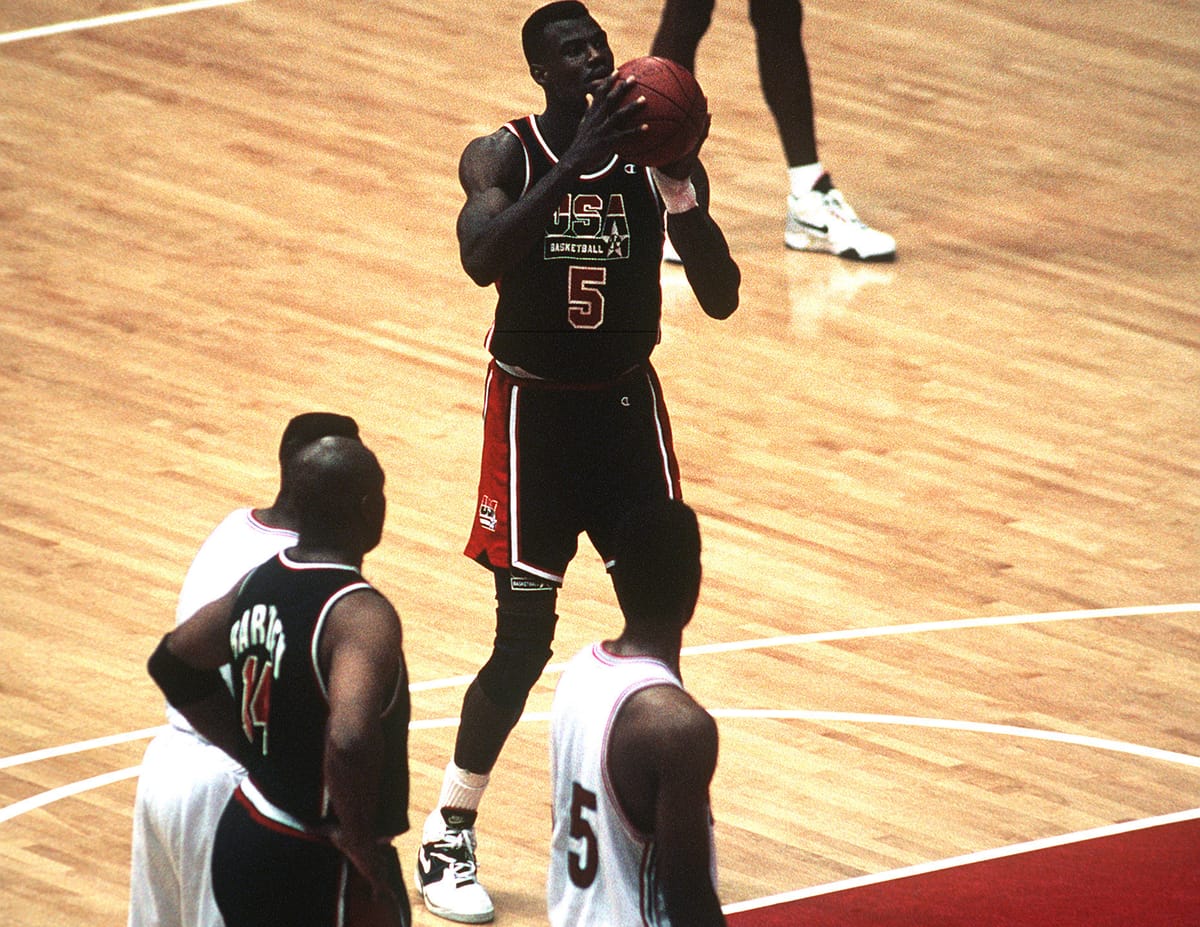
- TEAM UNIFORM
- REEBOK VISIBILITY
- JORDAN IDENTITY
- NIKE RELATIONSHIP
- TELEVISED CEREMONY
Illustrative photo: the U.S. men’s basketball team at the 1992 Olympics in Barcelona (David Robinson shooting a free throw against Puerto Rico, August 4, 1992). It is not the medal ceremony or the warm-up jacket. Logos from more than one company are visible on the uniforms and shoes. The jacket account comes from the Sotheby’s article and does not disclose every contract term.
Credit: Photo: Ken Hackman, U.S. Air Force, via the U.S. National Archives and Wikimedia Commons (public domain), cropped for this edition. Jacket account: Sotheby’s, The Ultimate Symbol of Michael Jordan’s Loyalty to Nike? A Reebok Jacket, June 20, 2023. Source record ↗What the record shows
The photo is illustrative and does not show the jacket, the medal ceremony or any Reebok mark. The Sotheby’s article supports the account that Jordan used the U.S. flag to obscure the Reebok mark and that safety pins remained with the jacket. It is not an IOC adjudication or a legal conclusion about sponsorship obligations.
Exclusivity can be commercially reasonable. A company may not want a creator promoting a direct competitor during a launch. A creator may charge for the opportunities they must decline. The problem is not the existence of a fence. It is a fence no one can locate.
One self-managed creator described negotiating a short restriction involving a narrow group of butter brands, then finding contract language broad enough to reach spreads, dairy, milk, cheese, yogurt, food retail, and adjacent categories. Her point was not that exclusivity is always improper. It was that a small-sounding category can quietly close much more of a creator’s future calendar.
At least five dimensions matter:
- Category: all beauty, all skincare, or one product type?
- Competitors: named companies, a defined class, or an approval process?
- Activity: paid endorsements only, or also organic mentions, existing content, affiliate links, appearances, and investments?
- Territory and platform: everywhere, or only the market and channels used by the campaign?
- Time: production, launch, active media, a post-term tail, or an indefinite restriction?
Exclusivity is purchased control over a bounded part of the creator’s opportunity set. The payment is not only for the post that appears. It may also compensate for the work that cannot appear, the inquiries that must be declined, and the category association that can persist after the formal term.
Michael Jordan covering the Reebok logo on his warm-up jacket at the 1992 Olympic medal ceremony remains an unusually literal image of the problem. Contemporary reporting documented the flag covering the Reebok mark; later oral histories describe the collision among the U.S. team uniform, Reebok’s visibility, Jordan’s Nike relationship, and a globally televised ceremony.
A photograph of that moment cannot reveal every contract term, and this article does not ask it to. Its value is visual: multiple commercial systems met on one person’s body, and the conflict had to be managed in public.
A narrow, named, three-week restriction is not economically or operationally equivalent to “no competitors worldwide for one year.” Price follows the actual fence.
Draw the route before pricing the journey
The route card
Price the commercial route around the file, not the file in isolation.
Credit: Worksheet design by Institutions of One / RN Collins, from The Asset’s Afterlife. Newsletter version ↗What the record shows
Educational workflow, not legal advice or a substitute for reviewing the governing agreement and live platform controls.
For each asset, complete this route card:
- Mechanism: organic post, repost, embed, native upload, paid ad, email, retail, or other.
- Identity: whose account, handle, face, voice, performance, or endorsement appears?
- Placement: exact accounts, pages, retailers, affiliates, or media.
- Edits: approved versions and authority over crops, cutdowns, captions, claims, translations, dubbing, and other changes.
- Duration: active use, paid-delivery stop, takedown, archive, renewal, and materials outside practical control.
- Territory: target market, availability, language, product, retailer, and authorized entities.
- Exclusivity: category, named competitors or approval method, covered activities, platforms, territory, and time.
- Evidence: final approved asset, agreement, permission record, campaign identifiers, live-placement captures, paid-media report if agreed, and closeout date.
Then ask one final question:
Does the contract describe the route the campaign team is actually about to build?
The asset’s value is not contained only in the file. Value changes with the route around it, and with the person, account, market, time, and future opportunities the route carries along.
Sources and further reading
- Meta for Developers, Instagram Creator Marketplace API
- Meta Help, What is the Meta Ad Library and how do I search it?
- YouTube Help, Embed Videos and Playlists
- FTC, Endorsements, Influencers, and Reviews
- FTC, Disclosures 101 for Social Media Influencers
- Hope Batchelor, “10 Red Flags I Spot in Almost Every Creator Contract I Receive”
- Roxanne / Travel Creator CEO, “5 Brand Contract Terms Every Content Creator Should Know”
- The Washington Post, contemporaneous report from the 1992 Olympic medal ceremony
- GQ, “The Dream Will Never Die: An Oral History of the Dream Team”
General educational information, not legal advice. Contract wording, platform functions, advertising rules, market practices, and applicable law can change the result.