 P01
P01 P02
P02 P03
P03Edition 005 · Complete authoritative text
Imagine a brand agrees to pay a creator $2,000 for one video.
The sentence sounds finished. It even has the comforting precision of a number.
But what, exactly, did the $2,000 buy?
The creator may have researched the product, developed the concept, written the script, found a location, appeared on camera, filmed the footage, edited the video, added captions, handled revisions, exported the approved version, and delivered it. That is the work of making the thing.
Then there is the work the video may do after delivery. The brand may want to publish it on one social account. Or run it as an advertisement. Or place it on a product page. Or send it to retailers. Or crop it, translate it, cut it into several versions, keep using it next year, and ask another agency to do the same.
And behind both sits a third question: is any copyright interest changing hands?
One agreement can answer all of those questions. One fee can cover all of them. But the amount, by itself, does not reveal the answers.
That is the structural problem hidden inside a great deal of creator work. A sponsored video looks like one object moving through one transaction. In practice, it can contain labor, deliverables, permissions, performances, production files, and future options. Trouble begins when the creator hears “one finished video,” the marketing team hears “campaign asset,” and everyone assumes the invoice settled the difference.
The invoice proves a payment—not the entire deal
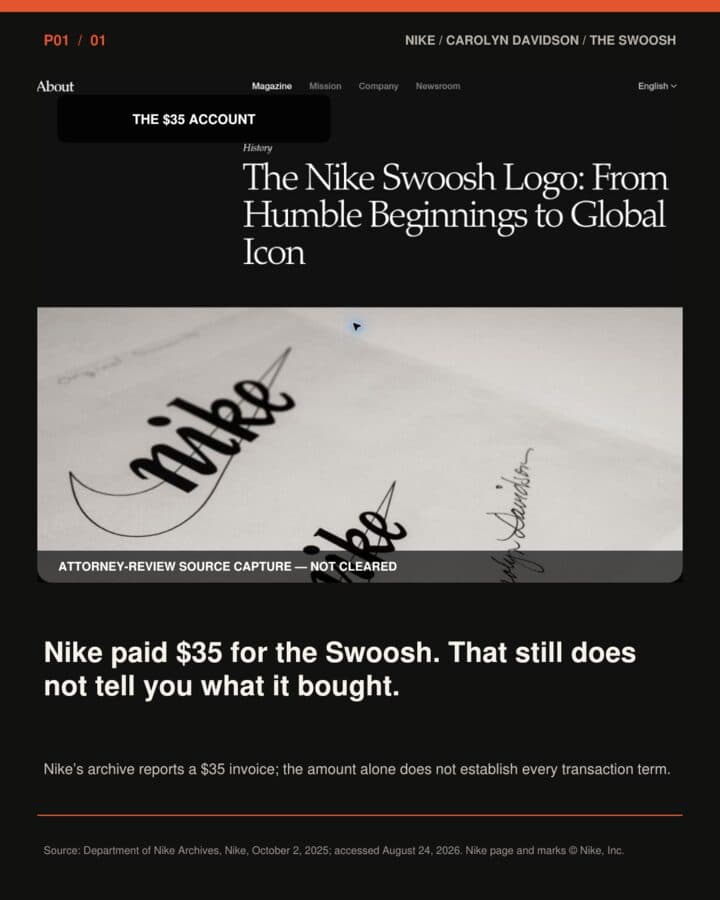
One of the most famous small invoices in design history is Carolyn Davidson’s $35 bill for the work that produced Nike’s Swoosh. Nike’s own archive says Davidson was paid two dollars an hour for earlier graphics and later submitted a $35 invoice for the mark. The company’s archive can document the assignment, the payment, and the design’s extraordinary afterlife.
The invoice cannot tell us every term that surrounded the work.
That limitation is precisely why it is useful here. A payment record can establish that money changed hands for creative work. It does not necessarily tell us, without the operative agreement and surrounding facts, which uses were authorized, which rights moved, what remained with the creator, or how later arrangements were handled.
The visible object is just as seductive. The Swoosh now lives on shoes, clothing, buildings, screens, packaging, and advertisements around the world. Its enormous public life does not allow us to reverse-engineer every private term from the mark alone.
So the first discipline is to stop asking one record to answer three different questions:
- Create: What work will be performed, and what finished deliverables will be supplied?
- Use: What may the commissioning party do with those deliverables?
- Own: Will any copyright interest change hands, and exactly which one?
These questions are connected. They are not interchangeable.
The file, the rights, and the person holding them
Federal copyright law gives this distinction some structure.
Copyright ordinarily begins with the author or authors of a protected work. A qualifying work made for hire follows a different rule, which the next article in this series examines. Copyright ownership can also be divided: particular exclusive rights, and even subdivisions of those rights, may be transferred and owned separately.
The law also distinguishes the thing carrying a work from copyright in the work itself. Under 17 U.S.C. §202, owning a material object in which a work appears does not, by itself, convey copyright in the work. In digital production, the practical analogy needs care—a file is not identical to every physical-object example contemplated by the statute—but the operational warning remains important. Receiving a final MP4 does not silently answer every question about the rights attached to its contents.
Section 106 identifies exclusive rights including reproduction, preparation of derivative works, distribution, public performance, and public display, subject to the limitations elsewhere in Title 17. A commercial agreement may authorize some relevant acts, restrict others, divide them by channel or market, or transfer an ownership interest. The actual result depends on the work, relationship, wording, facts, and applicable law.
A transfer of copyright ownership also generally requires a signed writing under §204(a), subject to the statute’s exceptions. The statute distinguishes those transfers from nonexclusive licenses. This article does not attempt to decide whether an implied license exists in any particular creator relationship; that inquiry is too fact- and jurisdiction-sensitive to turn into a casual sentence.
The point is narrower and more useful: “We paid for it” is not a reliable substitute for describing what was created, what may be done with it, and whether ownership changes.
Current commercial systems make the separation visible. Canva’s Contributor Agreement says it does not transfer contributor copyright to Canva, then separately grants Canva a broad, worldwide, nonexclusive license for submitted stock media. Those are Canva’s terms—not a model for every creator deal. Their teaching value is that ownership and permission occupy different provisions because they perform different jobs.
“Full buyout” is the beginning of the conversation
The phrase full buyout tends to arrive with the confidence of a completed thought.
It should arrive with a decoder.
Full what?
Which asset? Which rights? Which media? Exclusive or nonexclusive? Which accounts, retailers, agencies, or affiliates may use it? In which markets? For how long? May it be cropped, translated, dubbed, adapted, or combined with new copy? May the creator still display the work in a portfolio? What happens at renewal?
Federal copyright law defines a transfer of copyright ownership. It does not supply one statutory scope for the commercial shorthand full buyout. People in a particular trade may share expectations around the term. Those expectations still need to become operative details if the people making, paying for, publishing, and archiving the work are going to follow the same map.
Consumer interfaces offer a useful analogy, as long as the analogy stays in its lane. Apple’s services may display a Buy control, while the current U.S. Apple Media Services Terms govern the transaction, usage rules, country or territory, and continuing availability. Those terms say purchased content will generally remain available for download or access but may later be removed and become unavailable for further download or access.
That does not tell us what a creator buyout means. Consumer content purchases and creator contracts are not legally equivalent. The example shows something simpler: a confident button label can coexist with a much longer set of operative terms.
The practical response to “We need a full buyout” is therefore neither automatic refusal nor automatic agreement:
Tell me what the campaign needs to do with the work. Then we can name and price that scope.
Clearer scope is not anti-brand. It helps a brand identify the permissions its campaign actually requires. It helps a creator identify the future value being granted, restricted, or retained. It gives the production, marketing, finance, and legal functions a shared object instead of four private interpretations of the same two words.
The final video is not the complete source package
Even after the finished use is understood, a new request often appears near delivery:
Can you send all the files too?
Again, the sentence sounds precise until someone tries to build the folder.
Does “all the files” mean the approved final export? A small set of clean alternate takes? The raw footage? The editing project? Linked graphics? Audio stems? Caption files? Fonts? Plugins? Rejected concepts? Footage of people or locations that never appeared in the approved cut?
Depending on the project, those materials may make localization, repair, accessibility, versioning, or a later campaign easier. Preparing them can also require real labor: organizing and naming files, collecting dependencies, checking links, documenting formats, calculating storage, generating checksums, transferring the package, answering questions, and deciding what must be excluded.
Software exposes that hidden work. Adobe Premiere’s current documentation describes a Project Manager workflow for collecting a project and its media when moving work to another computer. Illustrator has a packaging workflow for gathering a document, linked graphics, and a package report. Even then, placing an asset in a folder does not grant permission to redistribute every font, stock element, music track, or collaborator contribution inside it.
Fiverr makes a narrower operational distinction. Its current Help Center guidance describes source files as an optional extra in eligible categories and provides a distinct source-file upload step at delivery. That is evidence of Fiverr’s workflow, not a universal rule that source files must always be separate, must always cost more, or must always remain with the creator.
The safer production conversation identifies the delivery tier before the deadline:
- Finished deliverables: the final approved files in the named formats.
- Selected clean materials: specified additional takes, crops, or approved alternates.
- Complete source package: the defined project files, linked media, graphics, audio, captions, reports, and dependencies needed for the agreed continuation of that project—plus any exclusions.
Then ask a second question: what may the recipient do with the source package?
Receiving files does not, by itself, answer the rights attached to every element inside them. Access, ownership, permission, privacy, performer consent, confidentiality, and third-party licenses may still need their own records.
A better first conversation
A creator deal does not have to begin as a miniature law-school exam. It can begin as a production record clear enough to expose disagreement:
Operational scoping example—not model contract language or a substitute for counsel: We are commissioning one 45-second vertical video and two approved cutdowns. The fee includes concept development, filming, one revision round, and delivery of the named final files. The brand may post those finished assets organically on its named social accounts for 90 days. Paid amplification, additional editing, retailer use, source files, exclusivity, and any transfer of copyright ownership are outside this production scope unless separately addressed in writing.
That paragraph does not answer every legal or operational question. It is already more useful than “one video, full buyout, send everything.”
The goal is not to make ordinary production unbearable. It is to surface a mismatch before the campaign depends on it—when the creator and brand can still name the deliverables, uses, and future responsibilities without reverse-engineering them from an invoice and a folder of mystery files.
A sponsored video can require the work of a small studio, publisher, licensing desk, performer, project manager, archivist, and commercial partner. Sometimes several of those roles sit with one person.
That person is not “just posting.”
They may be operating an institution small enough to fit inside a single invoice.
Keepable tool: the deal record
Before agreeing to a rate, complete these sentences separately:
- We are making and delivering: …
- The partner may use it: …
- Ownership will: …
- Source material included: …
- Anything else requires: …
One fee may cover every line. The point is that everyone can read the same answers.
Sources and further reading
- 17 U.S.C. §§101 and 106
- 17 U.S.C. §§201, 202, and 204
- U.S. Copyright Office, Copyright Basics (Circular 1)
- Nike, *The Nike Swoosh Logo: From Humble Beginnings to Global Icon*
- Canva Contributor Agreement
- Apple Media Services Terms and Conditions, U.S.
- Apple Support, *About purchasing movies, TV shows, music, books, and ringtones from Apple*
- Fiverr Help, *Managing Gig extras, source files, and shipping*
- Adobe Premiere, *Move Premiere projects to another computer*
- Adobe Illustrator, *Package files in Illustrator*
General educational information, not legal advice. The agreement, work, relationship, jurisdiction, platform rules, licenses, and surrounding facts can change the analysis.